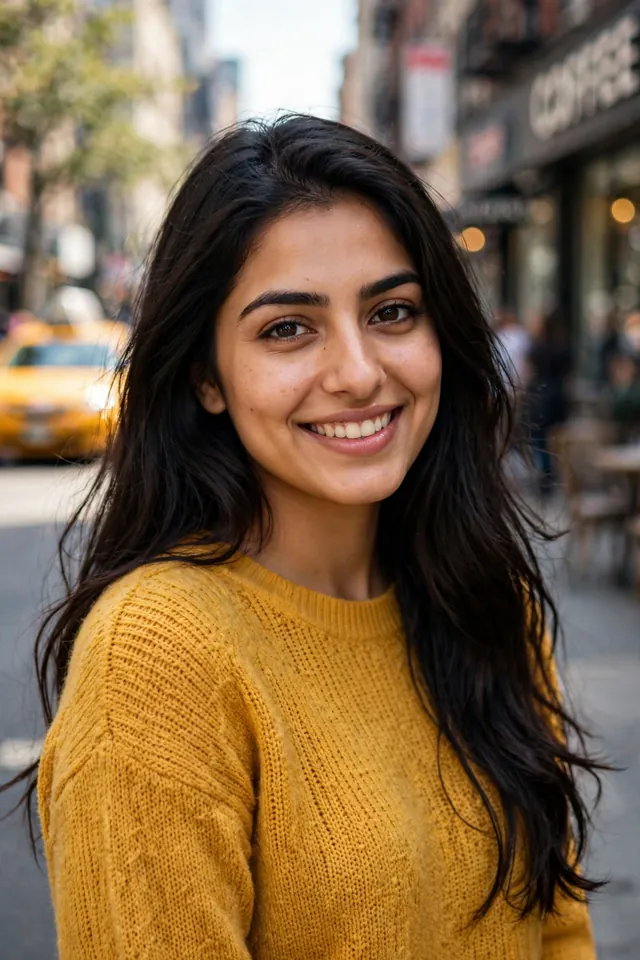
Sara, 28
I find stories hidden in numbers — and I'm hoping our story is the best one yet.














Say salaam
Chat with me
Pick a language, tap a quick reply — or just type your own message.

Fun compatibility quiz
Are we a vibe?
Five quick questions. No wrong answers — just for fun.
Quick facts
Tap a card
Your turn
Quick poll
What's the best NYC date Sara could plan?
Thanks — your vote is saved in this browser.
Keep exploring
Matched profiles
More profiles you might like to meet.


The 7 train rattles beneath Queens while I stare at my laptop, and somewhere in the thousandth row of a spreadsheet, a pattern blinks back at me. Most people see numbers. I see stories — who is struggling, who is thriving, what changed and why. I have been reading stories in numbers since I was eight years old, sitting at our kitchen table while my father, a yellow-cab driver with a mathematician’s soul, slid puzzle books across to me. “Sara beta,” he would say, tapping a particularly nasty logic puzzle, “numbers never lie, but you have to ask them the right questions.” I have been asking ever since.
I grew up in Jackson Heights, Queens, in an apartment where three languages collided daily and the smell of my mother’s cooking competed with the neighbors’. My mother worked double shifts as a nurse’s aide, and I learned my hardest lesson watching her: dignity is not about what you do, it’s about how you do it. She came home exhausted and still helped me with homework. My father drove his cab twelve hours a day and still found energy for our puzzle nights. Hard work wasn’t discussed in our house. It was simply the air we breathed.
School was my launchpad. Math competitions, science fairs, a scholarship to a good university — I collected them the way other kids collected sneakers. Statistics chose me, really: it was the field where my father’s puzzles met the real world. I earned my bachelor’s, then my master’s in statistics, working part-time as a teaching assistant and explaining p-values to undergraduates who looked at me the way I once looked at my father’s hardest puzzles. I loved teaching. I still do.
My first real job was at a small e-commerce startup in Manhattan — twelve people, one espresso machine, infinite ambition. Six months in, I was asked to analyze the impact of a new fee structure on sellers. The numbers told an uncomfortable story: the fees were quietly crushing small immigrant vendors — the halal grocer in the Bronx, the sari seller in Edison — while barely affecting the big sellers. I could have just delivered the chart. Instead, I built a full presentation, vendor by vendor, story by story, and asked for ten minutes with the CEO. My hands were shaking. He listened in silence, asked three sharp questions, and reversed the policy the following week. A month later, thank-you notes arrived at our office in five languages. One, from the Bronx grocer, said simply: “You saw us.” That is when I understood what my father meant. Numbers never lie — but they only matter when someone listens to what they’re saying about people.
Today I am a data analyst at a fintech company in Midtown, building dashboards that executives actually read and mentoring two interns — both first-generation college students, both brilliant, both reminding me of myself. I tell them what I wish someone had told me: ask the uncomfortable question, document everything, and never let anyone make you feel small for caring about the humans behind the data.
New York shaped me, but my roots run deep. Sunday is biryani day — I cook my mother’s recipe while video-calling her for supervision, because some steps she still refuses to write down (“andaaza, beta, andaaza”). My mornings belong to Central Park: I run the reservoir loop three times a week, rain or shine, plotting the day’s analyses in my head. I am a Broadway lottery devotee — I have seen six shows for under forty dollars each and I will defend this hobby fiercely. And late at night, I read Urdu novels, the language of my grandparents, keeping that thread unbroken across the ocean.
My values are my parents’ values, polished by the city: honesty without cruelty, curiosity without arrogance, and humility as a discipline — especially on the days the numbers make me feel clever. I believe success means nothing if you forget where you came from, that kindness scales better than any algorithm, and that the best question is often the simplest one nobody thought to ask.
What am I looking for? A man between 29 and 36 — intelligent, genuinely funny (this is non-negotiable; I laugh loudly and often), and family-oriented in the real sense: someone who calls his mother without being reminded. I need a partner with grounded ambition — building something meaningful, not just chasing titles. He should respect my career and my odd hours during quarter-close, love food as much as I do, and be ready for spirited debates about everything from cricket to the best subway line. Emotional maturity matters more to me than any resume line.
My dreams are big but specific: I want to move into data science for nonprofits — using the skills the city taught me to serve causes that matter. I want to teach statistics to girls who think math isn’t for them, the way I once needed someone to tell me it was. And personally, I dream of a partnership that feels like my parents’ kitchen table: warm, honest, full of laughter, where big dreams are taken seriously and nobody is ever too tired to listen. If you’re someone who believes the best stories are the true ones — and that ours might be worth writing — then let’s talk. I’ll bring the data. You bring the chai. We’ll see what patterns emerge.
Profiles on Tinder PRO are fictional, AI-generated illustrations for entertainment. Chat replies are automated; quizzes and polls run in your browser. No real matches are guaranteed.