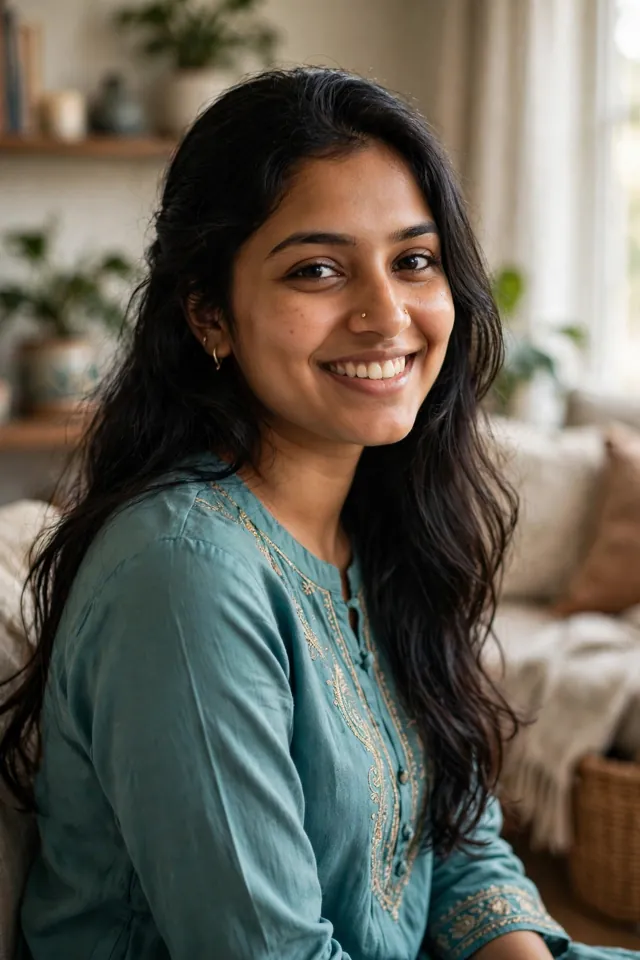
Ayesha, 24
A Lahore teacher who believes every child — and every heart — deserves patience.














Say salaam
Chat with me
Pick a language, tap a quick reply — or just type your own message.

Fun compatibility quiz
Are we a vibe?
Five quick questions. No wrong answers — just for fun.
Quick facts
Tap a card
Your turn
Quick poll
What makes the best first date?
Thanks — your vote is saved in this browser.
Keep exploring
Matched profiles
More profiles you might like to meet.

The school bell at the government girls’ school in Mozang rings at exactly 7:45, and Ayesha is always at the gate before it does. Not because anyone checks, but because thirty-two girls in blue-and-white uniforms will come running toward her like she is the best part of their morning. “Miss Ayesha!” they shout, and she crouches down to their level every single time, as if the first hello of the day is a small ceremony worth doing properly.
Ayesha grew up in the old city, in a narrow lane off Anarkali where the scent of frying samosas mixed with the sound of someone always reciting the Quran. Her dada, a retired postman with a magnificent white beard, was the family’s unofficial storyteller. Every evening after Maghrib, the children of the lane would gather on his charpai while he spun tales of Heer and Ranjha, of clever jackals and kind kings. “A story,” he used to say, tapping Ayesha’s forehead, “is the cheapest way to travel the world.” She believed him completely, and she still does.
Her mother is a homemaker with the patience of a saint and the memory of an elephant — she remembers every child’s birthday in the extended family. Her father drives a rickshaw and has the proudest smile in Lahore whenever anyone mentions his daughter, the teacher. Then there is Daniyal, her younger brother, twenty-one and studying engineering, who pretends to be annoyed when Ayesha fusses over him but secretly saves her a seat at every family dawat.
Ayesha did not stumble into teaching; teaching found her in Class 8, in the form of Miss Rukhsana, a stern-eyed woman who noticed that quiet Ayesha wrote beautiful essays and read one aloud to the whole class. “This girl,” Miss Rukhsana announced, “has words in her that the world needs.” Ayesha went home glowing that day. Years later, when she completed her Masters in Education from Punjab University, Miss Rukhsana — now retired and frail — came to the convocation. Ayesha touched her feet, and they both cried a little.
Her classroom today smells of chalk dust and possibility. The walls are covered with charts the girls made themselves: the water cycle drawn in glitter, a map of Pakistan with every province labeled in careful Urdu. Ayesha teaches Class 5 — English, Urdu, and Islamiat — and she has a rule: no child is ever laughed at for a wrong answer in her room. “Wrong answers,” she tells them, “are just right answers wearing a disguise.”
Ask her about her most memorable day, and she will tell you about Hira. Hira joined in October, a thin nine-year-old who had lost her mother that summer and had not spoken a single word in school for two months. The other teachers had gently given up. Ayesha did not push; she simply started reading stories aloud during the lunch break, sitting near Hira, asking nothing. For weeks, nothing. Then one Thursday, during a story about a sparrow who found her voice again, a small sound came from beside her. “Chirya udd gayi,” Hira whispered. The sparrow flew away. Ayesha kept reading as if her heart was not pounding out of her chest. By December, Hira was answering questions in class. “I did nothing special,” Ayesha insists. “I just waited. Children bloom on their own schedule — you only have to keep the sunlight steady.”
On Saturdays, Ayesha volunteers at a small community center in Shahdara, teaching basic reading to children who work during the week — little boys who polish shoes, girls who help their mothers with stitching. She brings them picture books bought with her own salary and biscuits she bakes on Friday nights. “These kids are the smartest people I know,” she says fiercely. “They just never got a classroom. So I bring the classroom to them.”
When the school week ends, Ayesha recharges in the simplest ways. She loves long drives — Daniyal at the wheel, old Noor Jahan songs crackling on the radio, the Canal Road stretching ahead under Lahore’s honey-colored evening light. She is a devoted chai drinker: doodh patti with extra elaichi from the dhaba near Lakshmi Chowk, sipped slowly while watching the city go by. And she reads Urdu poetry the way other people breathe — Faiz for courage, Parveen Shakir for tenderness. Her favorite couplet, which she has written on the inside cover of every diary since she was sixteen, is Faiz’s: “Mujh se pehli si mohabbat mere mehboob na maang” — though she laughs and says she is still waiting for someone worthy of the second line.
Ask about her values and she becomes serious in the gentlest way. Deen matters to her — she prays five times a day and finds in it the calm center of her busy life. Family is sacred; Sunday lunches at her parents’ home are non-negotiable. Honesty, kindness to the less fortunate, and a sense of humor that can survive a bad day — these are the things she measures people by, including herself.
So what is she looking for? “Someone between twenty-six and thirty-two,” she says, a little shyly, “educated, with a kind heart and a family he loves. He should respect my work — teaching is not a hobby for me, it is my life’s calling. And he must make me laugh. Life is too short for a serious face at the dinner table.” She dreams, one day, of opening a small school for underprivileged girls in Lahore — “just two rooms to start, with big windows and a library corner” — and she wants a partner who hears that dream and says, “Let’s build it,” instead of, “That’s nice, dear.”
Until then, she will be at the school gate at 7:44, crouching down for the morning hellos, keeping the sunlight steady. Somewhere out there, she believes, is someone who understands that the quietest people often love the deepest — and who is ready to be loved like a well-told story: patiently, completely, and for a very long time.
Profiles on Tinder PRO are fictional, AI-generated illustrations for entertainment. Chat replies are automated; quizzes and polls run in your browser. No real matches are guaranteed.