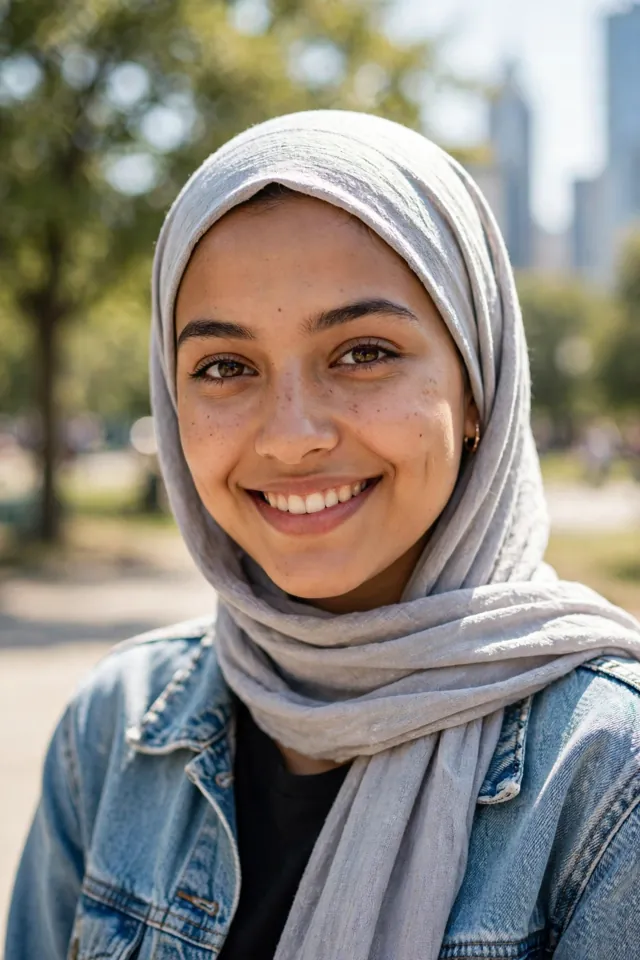
Sana, 26
Chicago hijabi teacher helping little hearts grow — looking for a partner building a faith-filled, laughter-filled home.














Say salaam
Chat with me
Pick a language, tap a quick reply — or just type your own message.

Fun compatibility quiz
Are we a vibe?
Five quick questions. No wrong answers — just for fun.
Quick facts
Tap a card
Your turn
Quick poll
Were YOU the quiet kid or the talkative one?
Thanks — your vote is saved in this browser.
Keep exploring
Matched profiles
More profiles you might like to meet.



The first snow of the year in Chicago has a sound — a hush that falls over the whole city, as if someone turned the volume down. I was seven the first time I really noticed it, standing at our apartment window in the suburbs while my mother wrapped my scarf “properly” for the tenth time. Nineteen years later, I still stop what I’m doing when that hush arrives. My name is Sana, I’m twenty-six, I teach second grade, and I wear my hijab the way my grandmother wore hers: like a crown you never have to take off.
My parents came to America from Pakistan before I was born, carrying the usual immigrant inventory: degrees that needed re-certifying, recipes that needed no translation, and a determination so fierce it practically glowed. My father drives a taxi and knows every shortcut in Chicago; my mother is a nurse who has held more hands than I can count. They worked nights and weekends so my brother and I could have the one thing they wanted most for us: choices. Everything I am is built on their tired shoulders, and I never forget it.
I didn’t plan to become a teacher. I planned to become a lawyer — briefcase, arguments, the whole drama. Then, in my sophomore year of college, I volunteered at a weekend Islamic school to “build my resume,” and a six-year-old named Yusuf took my hand, looked up at my hijab, and whispered, “You look like my big sister.” Something in my chest rearranged itself. I changed my major the next semester. My father said, “Lawyers argue. Teachers build.” He was right, as usual.
My most memorable moment in teaching didn’t happen in a single day — it unfolded over months. Amira joined my class in October, a quiet seven-year-old who had just moved from another state. She wouldn’t speak. Not shy-quiet — silent. Weeks went by. Then one day I found a folded paper on my desk: a poem, in careful pencil, about snow. It was beautiful. I didn’t announce it. I just started a “poetry wall” in our classroom where anyone could pin anonymous poems. Within a month, the wall was full — and Amira, slowly, began to whisper her verses to a friend. By spring, she stood up at our class assembly and read her snow poem aloud to two hundred people. Her mother cried. I cried. The principal pretended not to cry. That wall is still up, and every year it fills again.
That year taught me the whole secret of teaching: children don’t need you to be perfect; they need you to be paying attention. Amira didn’t need fixing. She needed a wall. I think about that constantly — how many of us are just waiting for someone to notice the poem we’re too shy to read aloud. My classroom runs on that belief: every child seen, every voice given a wall.
My hijab is part of that story too. I started wearing it at fourteen, my own decision, and it has been — honestly — one of the most freeing choices of my life. In a world that constantly tells women their worth is in being looked at, I opted out of the whole exhausting game. Do I get stares sometimes? Sure. Do I also get the most wonderful conversations with curious strangers, and the instant sisterhood nod from hijabis across a crowded room? Absolutely. It is my identity, my faith made visible, and I wear it with joy.
Outside school, I live a quiet, full life. I practice Islamic geometric art — those impossible, perfect patterns that remind you the universe has an order. I cook my mother’s recipes and call her at every uncertain step (“Ammi, the daal looks weird” — “It’s fine, beta, keep stirring”). On weekends I walk along Lake Michigan, which in winter looks like the edge of the world and in summer looks like a miracle. And I read — children’s books mostly, professional research disguised as fun.
What do I value? Faith, first and always — it is the lens, not just a part of the picture. Patience: with seven-year-olds, with Chicago winters, with life’s timing. Kindness as a discipline, not a mood. And family — my parents’ sacrifices are a debt I repay by living well and loving fully. I want a home filled with the sound of children laughing, books everywhere, and the smell of something good on the stove.
Who am I looking for? A man between 27 and 33 who loves his deen — not as a checklist, but as a way of moving through the world. Kind, patient, with a gentle sense of humor. Someone who wants a family and understands that raising good humans is the greatest project there is. He should respect my work, because my students are not a “job” I clock out of — they’re two dozen little hearts I’m helping grow. And he should be ready for a mother-in-law whose biryani will ruin all other biryani for him forever.
My dreams are soft-spoken but stubborn. I want to write an illustrated children’s book starring a hijabi heroine — because every child deserves to see herself as the brave one in the story. I want to open a weekend learning center for immigrant kids, a place where no child ever feels invisible. And I want a little house with a reading nook, a garden my mother would approve of, and a husband who reads bedtime stories with different voices for every character.
So that’s me: a Chicago teacher in a hijab, still stopping for the first snow, still believing every child — and every person — has a poem waiting for the right wall. If that sounds like your kind of story, take the quiz below, or say salaam in the chat. I give excellent advice and even better chai recommendations. The chai part is genetic.
Profiles on Tinder PRO are fictional, AI-generated illustrations for entertainment. Chat replies are automated; quizzes and polls run in your browser. No real matches are guaranteed.