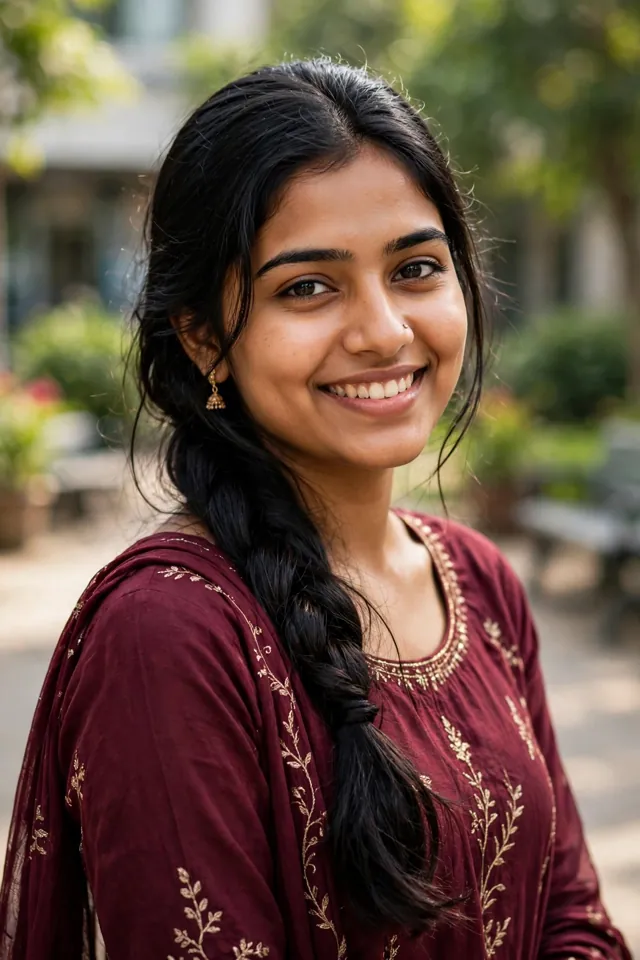
Priya, 26
A Mumbai pediatrician healing little hearts, one giggle at a time.














Say salaam
Chat with me
Pick a language, tap a quick reply — or just type your own message.

Fun compatibility quiz
Are we a vibe?
Five quick questions. No wrong answers — just for fun.
Quick facts
Tap a card
Your turn
Quick poll
Best comfort food?
Thanks — your vote is saved in this browser.
Keep exploring
Matched profiles
More profiles you might like to meet.
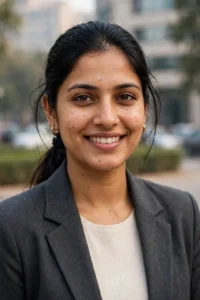


On the third floor of the children’s ward, there is a corridor where the strangest sound in any hospital can be heard: laughter. It bubbles out of Room 7 most afternoons, and if you follow it, you will find Dr. Priya sitting cross-legged on a hospital bed, wearing a stethoscope decorated with tiny stickers, making a puppet out of a surgical glove. “Medicine,” she says, grinning, “is only half the prescription. The other half is making them forget they’re scared.”
Priya grew up in a second-floor flat in Dadar, in the beautiful chaos of middle-class Mumbai — local trains rattling past the window, the evening aarti from the temple downstairs, her father’s old scooter puttering her to school. Her fondest childhood memory is of Marine Drive on Sunday evenings: her father buying her roasted corn, the sea breeze tangling her braid, both of them watching the sun melt into the Arabian Sea. “Queens Necklace,” her father would say as the streetlights flickered on. “One day you’ll shine like that, beta.”
The day that set her life’s course came when she was twelve. Her beloved grandmother — Ajji, who made the world’s best puran poli — fell seriously ill, and Priya watched the doctors work with a twelve-year-old’s terrified awe. Ajji recovered, but something in Priya had shifted permanently. She announced at the dinner table that night, with great solemnity: “I am going to become a doctor.” Her mother laughed. Her father said, “Then study.” So she did — with a ferocity that surprised even her teachers.
MBBS was five and a half years of beautiful brutality: anatomy halls at dawn, night duties that stretched into mornings, exams that felt like running marathons in the rain. Priya survived on cutting chai, her mother’s tiffins, and a stubbornness she inherited from Ajji. When it came time to choose a specialty, there was never really a choice. “Adults Google their symptoms and argue with you,” she laughs. “Children just want to know if the medicine tastes like strawberry. I knew where I belonged.”
Ask her for one story and she will tell you about Aarav, a six-year-old admitted with pneumonia, terrified of everyone in a white coat. For three days he hid under his blanket whenever Priya approached. So she stopped approaching with a stethoscope and started approaching with crayons. She drew terrible cats. He corrected her technique. By day five, he was sitting up, bossing her drawings around, and laughing — really laughing — for the first time since admission. On discharge day, he pressed a folded paper into her hand: a crayon drawing of a lady with a huge smile and a stethoscope, labeled in wobbly letters, “Best Doctor.” It is pinned above her desk to this day. “That paper,” she says softly, “is worth more than my degree.”
When the monsoon arrives in June, Priya becomes a child again. The first heavy rain sends her to Marine Drive with her college friends for cutting chai and bun maska, all of them getting gloriously drenched, exactly as they have done since they were seventeen. She loves the smell of wet earth, the way the whole city exhales, the drama of lightning over the sea. “Mumbai in the rains,” she declares, “is the most romantic city on earth. Fight me.”
Music runs through her family like a second bloodstream. Her grandfather played the harmonium; every evening of her childhood ended with him and her father singing old bhajans while Priya fell asleep on the cool floor. She trained in Hindustani classical vocal for six years — she is shy about it, but friends say her morning riyaz could make the neighbors weep. These days she hums old Kishore Kumar songs while doing rounds, and more than one nurse has caught a small patient humming along.
Her friends know her as the undefeated pani puri champion — fourteen in one legendary sitting at Elco Market, a record that has stood for three years. Weekend street-food crawls with her college gang are sacred: vada pav at Ashok, gola at Juhu, and long debates about which stall makes the crispiest dosa. “Food tastes better,” she insists, “when you’re laughing.”
She is close to her parents in a way that needs no announcement — Sunday lunches at home are non-negotiable, her mother still packs her tiffin, and her father still calls her his Queen’s Necklace. Her values are simple and non-negotiable: compassion as a daily practice, honesty even when it stings, family above everything, and the belief that a life spent easing someone’s pain is a life well spent.
What is she looking for? “Someone between twenty-seven and thirty-three,” she says, “educated, kind, with strong family values and a sense of humor. He should be good with children — or at least willing to learn my puppet techniques.” She wants a partner who will stand in the rain with her at Marine Drive, who understands that her patients sometimes come first, and who knows that the best medicine for a hard day is someone who listens.
Her dream is a free clinic for children in the chawls of Mumbai — “a bright, cheerful place with crayons in every room” — where no child’s treatment ever depends on their parents’ wallet. She is saving for it, rupee by rupee. Until then, she will be in Room 7, glove-puppet on hand, turning hospital corridors into places of laughter. Somewhere out there is someone who hears that laugh and recognizes it as home.
Profiles on Tinder PRO are fictional, AI-generated illustrations for entertainment. Chat replies are automated; quizzes and polls run in your browser. No real matches are guaranteed.