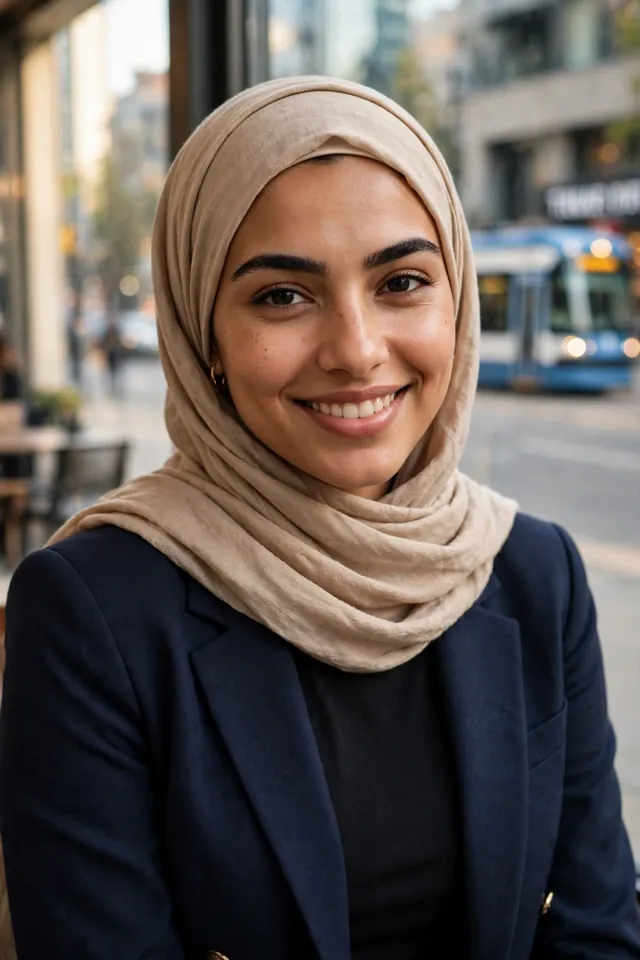
Fatima, 28
A Toronto engineer in a hijab, debugging code and stereotypes with equal flair.














Say salaam
Chat with me
Pick a language, tap a quick reply — or just type your own message.

Fun compatibility quiz
Are we a vibe?
Five quick questions. No wrong answers — just for fun.
Quick facts
Tap a card
Your turn
Quick poll
Best winter activity?
Thanks — your vote is saved in this browser.
Keep exploring
Matched profiles
More profiles you might like to meet.


It is 2 a.m. at a downtown Toronto hackathon, and Fatima is exactly where she wants to be: three empty coffee cups, a mechanical keyboard clacking like gunfire, and forty-five minutes to demo. Her teammate is quietly panicking. Fatima is grinning. “Relax,” she says, pushing up her sleeves. “Bugs fear me.” Twenty minutes later, the demo works, the judges applaud, and her team takes second place. On the streetcar home, she texts her mother: “Ammi, I won again. Sort of.” Her mother replies: “Mashallah. Did you eat?”
Fatima’s love affair with computers began in Karachi, in a small flat where her father — a bank clerk with big dreams for his daughter — brought home a clunky secondhand Pentium. She was nine. Within a month she had figured out more about it than the shopkeeper who sold it. By twelve she was writing tiny programs in BASIC and bossing around the neighborhood boys who came to “help” but mostly watched. “My father never once said computers weren’t for girls,” she says. “That one sentence shaped my entire life.”
At fourteen, the family emigrated to Toronto, and Fatima’s first Canadian memory is stepping off the plane into minus-twenty-degree air and thinking she had landed on another planet. The snow was magical for exactly one week. Then came the real challenge: a new school, a new accent to decode, and being the only hijabi in most of her classes. She handled it the way she handles everything — with wit as armor. When a classmate asked if her hijab meant she couldn’t use computers, she deadpanned, “Yes. I code telepathically.” He believed her for a week.
Her BSc in Computer Science was earned the hard way: scholarships, part-time TA work, and a legendary ability to survive on four hours of sleep. She loved the logic of it all — the clean honesty of code, which unlike people, always tells you exactly where you went wrong. As a visibly Muslim woman in tech, she has collected her share of odd looks and stupider questions, and she has answered every one with the same weapon: being undeniably excellent. “My code,” she likes to say, “does not care what I wear on my head.”
Hackathons are her happy place — the controlled chaos, the impossible deadlines, the 3 a.m. breakthroughs. She has the trophies to prove it, lined up on her desk next to a small plant named Kernel. But her proudest tech moment had nothing to do with winning. Two years ago, at 4 a.m. during a forty-eight-hour event, her team’s entire project crashed twenty minutes before judging. While everyone else spiraled, Fatima calmly rewrote the broken module from memory, her fingers flying, her chai going cold. They didn’t win. But a judge — a VP at a major firm — pulled her aside afterward and said, “I’ve never seen anyone debug under pressure like that.” She got a job offer the next week.
Her favorite hours, though, are spent far from any office. Every Saturday, Fatima mentors teenage girls learning to code at a community center in Scarborough. That’s where she met Mahnoor, fifteen, brilliant, and convinced that “girls like us don’t become engineers.” Fatima spent three months dismantling that belief, one Python lesson at a time. When Mahnoor’s first app — a prayer-time reminder with a beautiful interface — got a hundred downloads, she cried. Fatima pretended not to cry. “Representation,” Fatima says, suddenly serious, “is not a buzzword. It’s a fifteen-year-old girl seeing someone who looks like her doing the thing she dreams of.”
Toronto winters, which once horrified her, are now sacred: long snowy walks through High Park, boots crunching, the world gone quiet and white. Afterwards, a double-double from Tim Hortons — “the unofficial national drink, don’t argue” — and an evening of lo-fi beats while she works on side projects. She prays five times a day, fasts in Ramadan, and finds that faith and code share a secret: both reward patience, humility, and the willingness to start over when you’re wrong.
Family is her anchor: her parents, her younger sister who is studying law and steals her hoodies, and Friday dinners where her mother’s biryani draws the whole clan. Her values are Karachi-forged and Toronto-polished: honesty without cruelty, ambition without arrogance, humor as a survival strategy, and the unshakeable belief that kindness is a form of intelligence.
What is she looking for? “Twenty-eight to thirty-four,” she says crisply, “educated, respectful, ambitious — someone balancing deen and dunya like I try to. He must respect my career; I didn’t debug my way here to be debugged. And a sense of humor is non-negotiable — if you can’t laugh at my tabs-versus-spaces jokes, this won’t work.” She wants a partner for snowy walks and big dreams, someone who will cheer at her hackathons and steal her fries.
Her dream is a nonprofit bringing tech education to girls in underserved communities — “from Scarborough to Karachi” — because somewhere there is a nine-year-old girl staring at a clunky old computer, and Fatima wants to be the reason she never doubts she belongs. Until then: 2 a.m., keyboard clacking, bugs fearing her. And somewhere out there, someone who finds that the most attractive thing in the world.
Profiles on Tinder PRO are fictional, AI-generated illustrations for entertainment. Chat replies are automated; quizzes and polls run in your browser. No real matches are guaranteed.